


VisionAid: Smart Wearable Device
A Raspberry Pi-based wearable device that delivers real-time spoken navigation alerts to visually impaired users, built using YOLOv8n object detection and a priority-driven audio pipeline — for under ₹5,500.
A Raspberry Pi-based wearable device that delivers real-time spoken navigation alerts to visually impaired users, built using YOLOv8n object detection and a priority-driven audio pipeline — for under ₹5,500.

VisionAid is a focused, low-cost assistive device built for visually impaired individuals who need real-time awareness of their surroundings without relying on expensive commercial hardware. Inspired by the gap between what assistive AI can do and what most people can actually afford, it packs object detection, spatial reasoning, and speech synthesis into a single wearable that runs on a hat.
Built for students, researchers, and accessibility advocates, it provides an end-to-end pipeline that feels minimal yet capable — allowing users to wear it, switch it on, and receive spoken alerts like "person ahead" or "car to your right" without any screen, keyboard, or technical knowledge.
The idea behind VisionAid was to prove that meaningful assistive AI doesn't require a four-figure budget. Every decision — from choosing NCNN format for edge inference to frame-skipping for Pi 3B+ performance — was made to keep the system functional within real hardware constraints. It balances detection accuracy with practical usability, resulting in a device that costs ₹5,500 to build and does something that commercial alternatives charge ₹2,90,000 for.
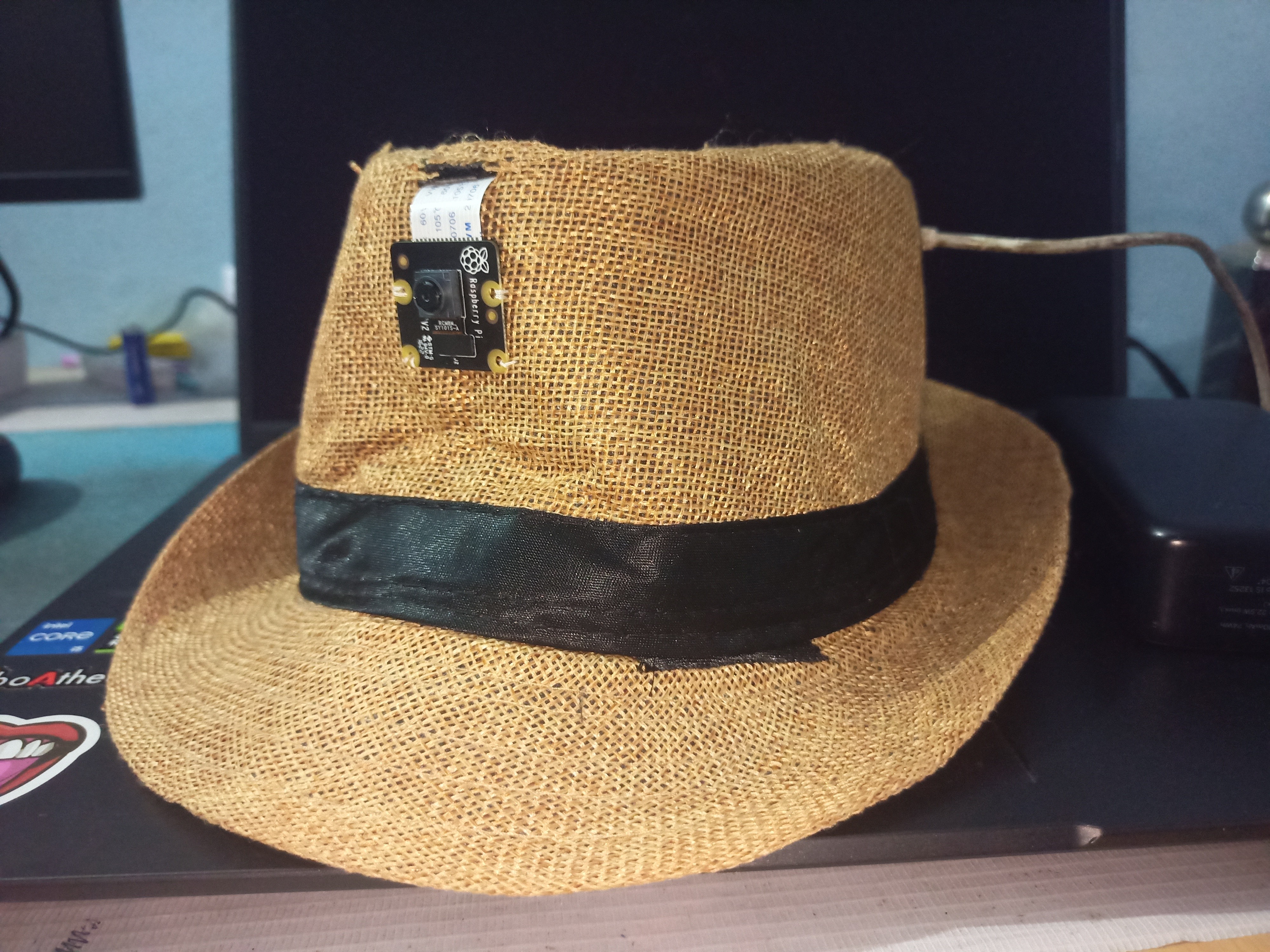

VisionAid is a proof-of-concept, and an honest one. Detection latency on the Pi 3B+ is real. Distance is estimated from bounding box area, not true depth. A single object is announced per cycle. These are known constraints with known solutions — offline TTS, a Pi 4B upgrade, object tracking across frames, and multi-object announcements are all planned next steps.
The foundation is solid enough to build on, and the cost is low enough that none of these upgrades are out of reach.
The broader point VisionAid makes is not about Raspberry Pi or YOLOv8. It's about access. A functional, wearable assistive device that identifies obstacles, localises them spatially, and speaks to the user in real time — built for under ₹6,000 — challenges the assumption that meaningful assistive technology requires a large budget or a commercial product team.
Awareness and effort, it turns out, go a long way.


